






Total Therapy Blog
Gearing Up for the Run… Built for Running?
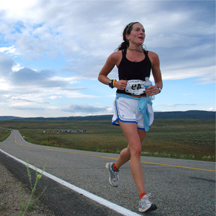 Welcome to our new series “Gearing Up for the Run”. We are excited for the upcoming Vancouver Sun Run and hope you are too! In the up-coming weeks, we will focus our energy on getting ready for the run. Running turns out to be very complicated biomechanically. In this first part, we will talk about the basics of running and answer the question: Are we Built for Running? Check back next week for our second part about coming up with a Running Plan.
Running for most of us is instinctive – our brain tells our body that we want to move faster, and the rest happens automatically. For this reason, it may be strange to hear that there is more to running than just moving your feet faster. Our bodies were built to move in a certain way, maximizing our biomechanics. (Biomechanics, as any kinesiologist or physiotherapist will tell you, is the study of how the body’s tissues and architecture react when subjected to movement or force). This week, we’ll focus on the biomechanics of running in an environment that increasingly challenges our body’s design.
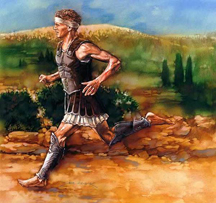 To understand the biomechanics of running, we have to go back in history a little. Our ancestors learned to run in a world without asphalt, concrete, and more importantly, shoes. They ran barefoot on the ground. In order to absorb the massive forces involved in running without destroying their feet or knees, they adapted a running gait that maximized the ability of the body’s tissues to absorb shock and dissipate it, while maximizing the efficiency of movement.
So what is this running gait? It starts at the feet: the point of impact should be on the balls of your feet (not toes, not heels). You should hit the ground with your foot underneath you, not stretched out in front. This way, your effort isn’t going into braking yourself, which would be the case if you landed with your foot out in front of you. From there, the foot should sweep underneath and behind you. You should open up at the hip as you extend the leg out, getting the final “kick” from your calves and glutes before your toe leaves the ground again. Following up to the torso, your core should be inclined slightly forward. The bulk of your effort should go into propelling yourself forward – you shouldn’t feel as if you’re bounding up and down, which wastes energy. Finally, your arms should be relaxed, swinging in a front-to-back direction, not side-to-side (which again, wastes energy).
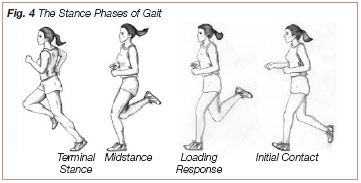
Today’s runner has gotten away from that original gait, mostly because of our reliance on heavily padded shoes and the overabundance of concrete and asphalt running surfaces. The problem with this, is that instead of distributing the force evenly throughout the limbs and trunk, the modern runner tends to slam down through the heel, jarring up through the knee, hip and low back. The modern runner bounces more as well, because they don’t get the feedback from their feet that they are hitting too hard, or bouncing too high. Moreover, the modern runner runs on a very even, uniform surface. As a result, the force experienced by their running pattern is very similar over long periods of time. This increases the likelihood of repetitive stress injuries.
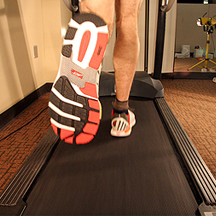 Whether you’re new to running, or an experienced endurance athlete, your gait matters. Your performance, efficiency, and likelihood of getting injured are tied to how you move. If you run with a friend, have them watch you run a few metres and get them to give you feedback on what you’re doing. If you don’t have a running partner, or you’re not sure of what to look for, you can also seek out a physiotherapist, kinesiologist, or even chiropractor who does running assessments. They can film your gait, and then analyze it with you to provide you with feedback on what you can do to improve it.
Next week, we’ll talk about getting started with a running plan.
To finish, we’d like to put a question out to you: what have you heard about running techniques, and what strategies do you use to run more efficiently? Share with us in the comment section below or on Facebook!
Don’t forget our New Website Launch Contest is still on! Help us reach 250 fans on Facebook and each fan will get a $20 coupon and a chance to win our Grand Prize! More details here.
Follow Us!
& Stay Up To Date
BLOG